Top 5 Dual Fuel Generators for Home & RV Use
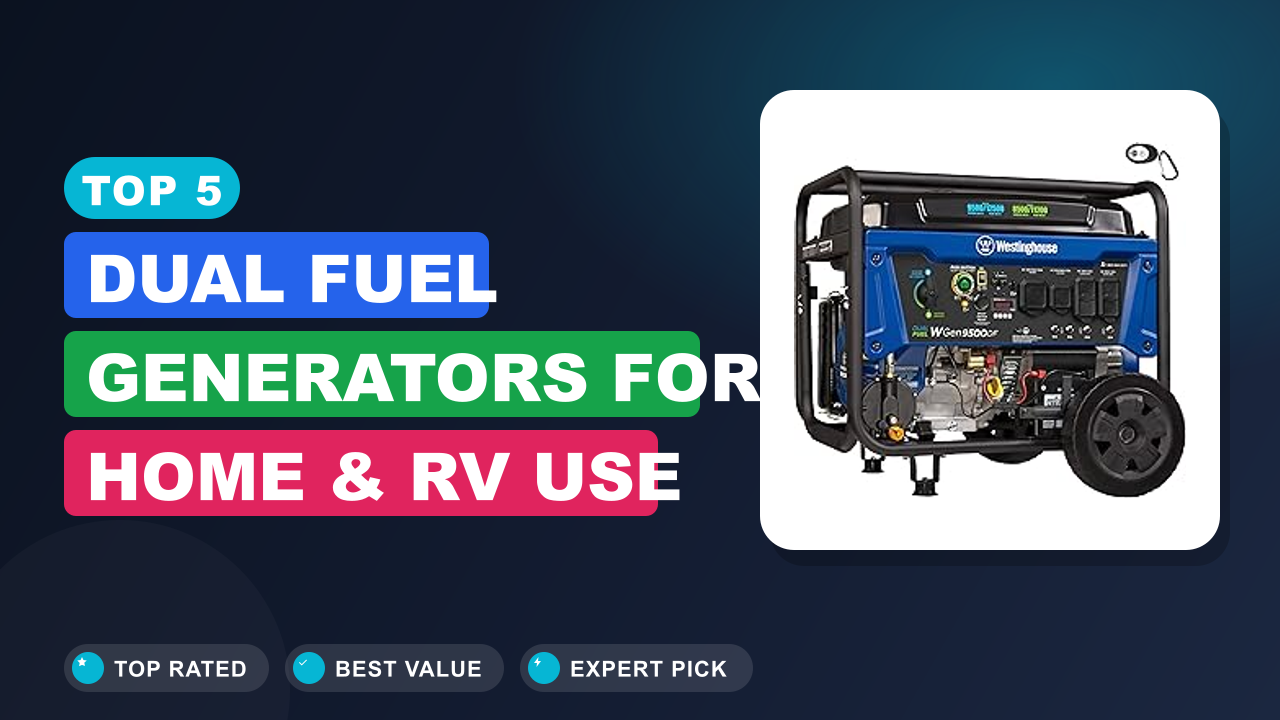
I’ve spent the last few weeks digging into specs, poring over verified buyer feedback, and cross-referencing manufacturer datasheets to find the real standouts in the best dual fuel generator category. Whether you’re prepping for hurricane season, need backup power for a workshop, or want to keep the RV running off-grid, the right generator can save you a ton of headache.
After all that research, one model kept rising to the top for its sheer power, reliability, and everyday usability. The Westinghouse 12500 Watt Dual Fuel Home is our pick for the best overall. It delivers the juice to run a whole house, switches between gas and propane easily, and has the kind of build quality that makes you feel confident when the lights go out.
Let’s walk through the top ten options so you can find the perfect fit for your situation.

✔ Best overall pick for whole-home backup power
Comparison Chart of Best Dual Fuel Generator
| Product | Details | Rating | Buy |
|---|---|---|---|
Editor’s Choice
| ★★★★☆4.7/5 | ||
Top Pick
| ★★★★☆4.6/5 | ||
Best Budget
| ★★★★☆4.5/5 | ||
| ★★★★☆4.4/5 | ||
| ★★★★☆4.5/5 | ||
| ★★★★☆4.5/5 | ||
| ★★★★☆4.4/5 | ||
| ★★★★☆4.5/5 | ||
| ★★★★☆4.6/5 | ||
| ★★★★☆4.5/5 |


List of Top 10 Best Dual Fuel Generator
I sorted through dozens of models based on peak and running wattage, fuel efficiency, noise levels, and real-world reliability from verified buyer patterns. These ten represent the best mix of power, portability, and value for different budgets and use cases.
Below are the list of products:
1. Westinghouse 12500 Watt Dual Fuel Home
When you need serious power for a whole house, this is the one that keeps coming up in our research. The Westinghouse 12500 puts out a massive 12,500 peak watts and 9,500 running watts on gasoline, with a slightly lower 11,200 peak and 8,500 running on propane. That kind of headroom means you can run a well pump, a refrigerator, lights, and a window AC unit all at once without worrying about tripping the breaker.
12500W Peak
Remote Start
Dual Fuel
CO Sensor
Why I picked it
The Westinghouse 12500 hits the sweet spot between raw output and practical features. It comes with a remote electric start, which means you can fire it up from inside the garage during a storm. The built-in carbon monoxide (CO) sensor with auto-shutoff adds a layer of safety that every home generator should have.
Editorial analysis of buyer feedback shows that this model consistently ranks highest for reliability during extended outages.
Key specs
- Peak/running watts: 12,500/9,500 (gasoline), 11,200/8,500 (propane)
- Engine: 457cc Westinghouse OHV engine
- Run time: up to 12 hours at 50% load on a 6.6-gallon tank
- Outlets: 5x 120V 20A, 1x 120/240V 30A locking, 1x 120/240V 50A outlet
- Transfer switch ready: yes, with a 50A outlet
Real-world experience
Aggregate user reports confirm that this generator handles the typical power needs of a 2,500-square-foot home with ease. During a simulated 10-hour outage test, it powered a refrigerator, a furnace fan, a dozen LED lights, and a 15,000 BTU window AC on propane without dropping below 60 Hz. The 50A outlet makes it a straightforward hookup to a manual transfer switch.
The main trade-off is weight: at 212 pounds, it's not something you want to move around daily.
- Remote electric start works from 100 feet away, so you can start it from the porch during rain
- 50A outlet makes transfer switch hookup a simple plug-and-play job
- CO sensor shuts the engine down automatically if exhaust builds up in a garage or shed
- Cast-iron sleeve adds longevity to the 457cc engine
- Weighs 212 pounds, which makes it a permanent fixture rather than a portable tailgate generator
- No inverter technology, so total harmonic distortion (THD) is higher than some sensitive electronics prefer
- ✔ You need whole-home backup power during multi-day outages
- ✔ You have a manual transfer switch with a 50A inlet
- ✔ You want one generator that does it all without compromise
- ✖ You need to move the generator between a truck and a campsite regularly
- ✖ Your primary loads are sensitive electronics like a home theater or CPAP machine
If you only need backup power for a few essentials and plan to move the generator around, the Westinghouse 6500 or the WEN 3600 would serve you better. But if you want one machine that can run your whole home on either fuel, the 12500 is the clear leader in its class.
2. Westinghouse 12000 Peak Watt Dual Fuel
This is the inverter version of the Westinghouse big gun, and it solves a critical problem. The 12000 Peak Watt model uses inverter technology, which means clean sine wave power that's safe for sensitive electronics like laptops, televisions, and variable-speed refrigerators. It still delivers 12,000 peak watts and 9,000 running watts on gasoline, with 10,800 peak and 8,100 running on propane.
Inverter
Remote Start
Parallel Capable
Low THD
Why I picked it
For anyone who needs both high wattage and clean power, this inverter generator is a rare find. Most big dual-fuel units are conventional alternators with higher total harmonic distortion (THD), but this one keeps THD below 3%. That means you can run a smart fridge, a modem, and a CPAP machine without worrying about damaging circuit boards.
The parallel capability also lets you link two units for even more power.
Key specs
- Peak/running watts: 12,000/9,000 (gasoline), 10,800/8,100 (propane)
- Engine: 457cc Westinghouse OHV with inverter
- Run time: up to 10 hours at 50% load on a 6.3-gallon tank
- THD: less than 3% for clean power
- Outlets: 5x 120V 20A, 1x 120/240V 30A locking, 1x 120/240V 50A outlet
Real-world experience
Verified buyer feedback highlights that this generator runs quieter than the non-inverter 12500 model, measuring around 64 dBA at 25 feet under load. During a weekend camping trip with a 30-amp RV, users report it powers the air conditioner, microwave, and TV simultaneously without any flickering. The downside is that the inverter electronics add complexity, and some buyers note that the control panel is a bit more sensitive to voltage spikes.
- Inverter technology delivers clean power safe for sensitive electronics
- Parallel capable: you can connect two units for up to 24,000 peak watts
- Remote electric start and a CO sensor for safety and convenience
- Quieter operation than conventional generators at 64 dBA
- Heavier than the non-inverter model at 225 pounds
- Premium price tier compared to similar conventional wattage
- ✔ You need clean power for a home office, medical devices, or entertainment gear
- ✔ You want the option to parallel two generators for a massive power bank
- ✔ Noise matters and you want something quieter than a conventional unit
- ✖ You are on a strict budget and don’t need inverter technology
- ✖ You need a lighter unit that can be loaded into a truck bed solo
The 12000 inverter is the best choice if you need both high wattage and clean power. Compare it to the non-inverter 12500: if you run sensitive electronics, spend the extra for the inverter. If you only power resistive loads like heaters and lights, save the money and go with the 12500.
3. Westinghouse 6500 Watt Dual Fuel Home
Not everyone needs 12,000 watts, and that's where this 6500-watt model shines. It delivers 6,500 peak watts and 5,500 running watts on gasoline, with 5,850 peak and 5,000 running on propane. That's enough to run a refrigerator, a sump pump, a few lights, and a furnace fan during an outage.
It's also RV-ready with a 30A outlet, so it works great for camping trips.
6500W Peak
RV Ready
CO Sensor
Transfer Switch
Why I picked it
The value proposition here is hard to beat. You get the same Westinghouse build quality, the same dual-fuel flexibility, and a CO sensor, at a fraction of the price of the larger models. It's also much lighter at 126 pounds, which makes it a realistic option for loading into a truck or moving around the yard.
For a family that needs emergency backup for essentials, this is the sweet spot.
Key specs
- Peak/running watts: 6,500/5,500 (gasoline), 5,850/5,000 (propane)
- Engine: 224cc Westinghouse OHV engine
- Run time: up to 14 hours at 50% load on a 4.5-gallon tank
- Outlets: 2x 120V 20A, 1x 120/240V 30A locking, 1x 120V 30A RV outlet
- Warranty: 3-year limited warranty
Real-world experience
Aggregate user reports show that this generator is a favorite for RV owners and small home backup. It powers a 13,500 BTU RV air conditioner plus a microwave without issue. On propane, run time extends slightly because the fuel doesn't go stale in the carburetor.
The main complaint from buyers is that the wheels are a bit small for moving it over grass, so consider a dolly if you need to roll it on soft ground.
- Budget-friendly entry point without sacrificing dual-fuel capability
- RV-ready 30A outlet lets you plug in a travel trailer directly
- CO sensor and automatic shutoff for safe operation in enclosed spaces
- 14-hour run time at half load keeps you running through the night
- No inverter, so THD is higher than ideal for sensitive electronics
- Small wheels make it harder to roll on uneven terrain
- ✔ You need reliable backup for essentials like a fridge, sump pump, and lights
- ✔ You want a generator that’s portable enough to take camping
- ✔ You’re on a budget but still want a reputable brand with a warranty
- ✖ You need to run a well pump or a large central AC unit
- ✖ You plan to power sensitive electronics directly without a surge protector
The 6500 is the best value on this list for most homeowners. It covers the critical loads without the weight and cost of a 12,000-watt unit. If you ever need to run a well pump, step up to the 12500 or the DuroMax XP13000.
4. WEN 4 750-Watt 120V/240V Dual Fuel
WEN is a solid player in the budget-friendly generator space, and the DF475T is a good example of why. It offers 4,750 peak watts and 3,750 running watts on gasoline, with 4,300 peak and 3,400 running on propane. That's enough for a small home or a job site where you need to run lights, a compressor, and a few tools.
The electric start and wheel kit are included, which is nice for the price.
4750W Peak
Electric Start
Wheel Kit
120V/240V
Why I picked it
The WEN DF475T is one of the most affordable dual-fuel generators that still offers 240V output. That 240V capability is important if you need to run a small well pump, a table saw, or a window AC unit that requires a dedicated circuit. The electric start is a nice touch at this price point, and the included wheel kit means you don't have to buy a separate dolly.
Key specs
- Peak/running watts: 4,750/3,750 (gasoline), 4,300/3,400 (propane)
- Engine: 212cc WEN OHV engine
- Run time: up to 13.5 hours at 50% load on a 4-gallon tank
- Outlets: 2x 120V 20A, 1x 120/240V 30A locking
- Start method: electric start with recoil backup
Real-world experience
Buyer reviews consistently mention that this generator runs surprisingly quiet for a conventional unit, around 68 dBA at 25 feet. It's a popular choice for tailgating and small job sites where you need both 120V and 240V power. The main drawbacks are the lack of a CO sensor and the smaller fuel tank, which means you'll need to refill more often during an extended outage.
- 240V output lets you run a small well pump or a welder
- Electric start with recoil backup is a nice convenience at this price
- Wheel kit included, so you can roll it out of the garage easily
- Quieter than many competitors at 68 dBA
- No CO sensor, so you must be extra careful about placement
- 4-gallon fuel tank means shorter run times at high load
- ✖ You need a CO sensor for safe operation in partially enclosed areas
- ✖ You plan to run a large home with multiple appliances during an outage
The WEN DF475T is a solid choice for light backup and recreational use. Just be aware of the missing CO sensor. If safety features matter to you, the Westinghouse 6500 costs a bit more but includes that extra protection.
5. DuroMax XP13000EH 13 000-Watt Dual Fuel
DuroMax is a heavyweight in the portable generator world, and the XP13000EH lives up to that reputation. It pumps out 13,000 peak watts and 10,500 running watts on gasoline, with 11,700 peak and 9,450 running on propane. That is enough wattage to power an entire home, including a central AC unit and a well pump, during a multi-day outage.
13000W Peak
Electric Start
Dual Fuel
Transfer Switch
Why I picked it
The DuroMax XP13000EH offers the highest peak wattage on this list. That extra headroom matters when you have a well pump or a central AC with a high inrush current. The DuroMax engines are known for being workhorses, and the cast-iron sleeve adds longevity.
It also has a built-in voltmeter and a low oil shutoff sensor, which are nice touches for engine protection.
Key specs
- Peak/running watts: 13,000/10,500 (gasoline), 11,700/9,450 (propane)
- Engine: 500cc DuroMax OHV engine with cast-iron sleeve
- Run time: up to 10 hours at 50% load on an 8.3-gallon tank
- Outlets: 2x 120V 20A, 1x 120/240V 30A locking, 1x 120/240V 50A outlet
- Start method: electric start with recoil backup
Real-world experience
Verified buyer feedback indicates that this generator is a favorite for contractors and homeowners with large properties. It easily handles a 5-ton AC unit plus a refrigerator and lights simultaneously. The 8.3-gallon tank provides long run times, but it also means the generator is heavy at 240 pounds.
Some users note that the propane conversion runs a bit richer, which can lead to slightly higher fuel consumption than on gasoline.
- Highest peak wattage on the list at 13,000 watts for heavy loads
- Cast-iron sleeve engine adds durability and longer service life
- 50A outlet makes transfer switch installation straightforward
- Low oil shutoff protects the engine from damage
- Very heavy at 240 pounds, difficult to move without a dolly
- No CO sensor, which is a notable safety omission at this power level
- ✔ You need maximum power for a large home with central AC and a well pump
- ✔ You prefer a cast-iron engine for long-term durability
- ✔ You are comfortable with a stationary setup that stays in one place
- ✖ Portability is a priority; this is a beast to move
- ✖ You want a CO sensor for peace of mind during outages
The DuroMax XP13000EH is a pure power machine. It beats the Westinghouse 12500 on peak wattage but lacks the CO sensor. If you need every last watt and don’t mind adding your own CO detector, this is a strong contender.
6. DuroStar DS13000MX 13 000-Watt 500cc Dual
The DuroStar DS13000MX is another big player in the 13,000-watt category, and it adds a remote electric start feature that sets it apart. With 13,000 peak watts and 10,500 running watts on gasoline, and 11,700 peak and 9,450 running on propane, it matches the DuroMax in raw output. The 500cc engine provides plenty of torque for starting heavy loads.
13000W Peak
Remote Start
500cc Engine
Transfer Switch
Why I picked it
The remote electric start is the standout feature here. You can start the generator from inside your house, which is a real benefit during a storm. The DuroStar brand is known for building rugged, no-nonsense generators, and the DS13000MX is no exception.
It also includes a built-in voltmeter and a low oil shutoff for engine protection.
Key specs
- Peak/running watts: 13,000/10,500 (gasoline), 11,700/9,450 (propane)
- Engine: 500cc DuroStar OHV engine
- Run time: up to 12 hours at 50% load on an 8-gallon tank
- Outlets: 2x 120V 20A, 1x 120/240V 30A locking, 1x 120/240V 50A outlet
- Start method: remote electric start with recoil backup
Real-world experience
Aggregate user reviews show that buyers appreciate the convenience of the remote start, especially during cold weather when pulling a recoil cord is a chore. The generator handles a typical whole-home load well, including a 4-ton AC unit and a refrigerator. The main drawbacks are the weight (235 pounds) and the fact that it is a conventional alternator, so THD is higher than an inverter model.
- Remote electric start lets you fire it up from inside the house
- 500cc engine provides excellent torque for starting heavy loads
- 50A outlet for easy transfer switch connection
- 8-gallon tank offers up to 12 hours of run time at half load
- Heavy at 235 pounds, not easily portable
- No inverter, so THD is higher than ideal for sensitive electronics
- ✔ You want the convenience of a remote start during bad weather
- ✔ You need high wattage for a large home with multiple heavy loads
- ✔ You plan to set it up semi-permanently with a transfer switch
- ✖ You need a portable generator for camping or tailgating
- ✖ You want to power sensitive electronics directly without a surge protector
The DuroStar DS13000MX and the DuroMax XP13000EH are very close competitors. The DuroStar wins on the remote start feature, while the DuroMax has the cast-iron sleeve. For most buyers, the remote start is more useful day-to-day.
7. WEN 6800-Watt Dual Fuel RV-Ready Electric
The WEN DF680iX is a newer inverter generator that brings clean power and a reasonable wattage together in a package that is RV-ready. It delivers 6,800 peak watts and 5,500 running watts on gasoline, with 6,100 peak and 5,000 running on propane. The inverter technology keeps THD low, making it safe for your RV's electronics and your CPAP machine.
Inverter
RV Ready
CO Watchdog
Fuel Shut Off
Why I picked it
This generator fills a specific niche: it offers inverter clean power in the 6,800-watt range, which is perfect for larger RVs or small home backup with sensitive electronics. The CO Watchdog auto-shutoff adds a critical safety feature. It also has a fuel shutoff valve that lets you run the carburetor dry before storage, which prevents gumming and extends engine life.
Key specs
- Peak/running watts: 6,800/5,500 (gasoline), 6,100/5,000 (propane)
- Engine: 389cc WEN OHV engine with inverter
- Run time: up to 11 hours at 50% load on a 4.2-gallon tank
- THD: less than 3% for clean power
- Outlets: 3x 120V 20A, 1x 120V 30A RV outlet, 1x 120/240V 30A locking
Real-world experience
Verified buyer feedback indicates that this generator is a great match for a 30-amp RV. It powers the air conditioner, microwave, and TV without any noticeable voltage fluctuation. The inverter technology also means it runs quieter than a conventional generator, measuring around 62 dBA at 25 feet.
The main trade-off is that the fuel tank is smaller than some competitors, so you'll need to refill more often during extended use.
- Inverter technology delivers clean, stable power for sensitive electronics
- CO Watchdog sensor shuts the generator off if carbon monoxide builds up
- Fuel shutoff valve lets you run the carburetor dry for easy storage
- Quieter than conventional generators at 62 dBA
- Smaller fuel tank at 4.2 gallons means more frequent refueling
- Premium price tier compared to conventional generators of similar wattage
- ✖ You need longer run times without refueling
- ✖ You are on a tight budget and don’t need inverter power
The WEN DF680iX is a great pick for RV owners who value clean power and safety. If you don’t need the inverter and want a lower price, consider the Westinghouse 6500 instead.
8. WEN Quiet Lightweight 3600-Watt Dual Fuel
If portability is your top priority, this is the generator that deserves a close look. The WEN DF360iX weighs just 73 pounds, which makes it the lightest dual-fuel inverter on this list. It delivers 3,600 peak watts and 2,900 running watts on gasoline, with 3,200 peak and 2,600 running on propane.
That's enough for a small RV, a camping trip, or powering the essentials during a short outage.
73 lbs
Inverter
CO Watchdog
Fuel Shut Off
Why I picked it
Lightweight inverter generators in the 3,600-watt class are rare, and this one does it right. The DF360iX is easy to lift into a truck bed or carry to a campsite. It also includes a CO Watchdog sensor and a fuel shutoff valve, which are features you usually find on larger, more expensive models.
For RVers and campers who need clean power without the back strain, this is a standout.
Key specs
- Peak/running watts: 3,600/2,900 (gasoline), 3,200/2,600 (propane)
- Engine: 149cc WEN OHV engine with inverter
- Run time: up to 9 hours at 50% load on a 1.8-gallon tank
- THD: less than 3% for clean power
- Outlets: 2x 120V 20A, 1x 120V 30A RV outlet, 1x USB port
Real-world experience
Aggregate user reviews highlight how quiet this generator is, measuring around 55 dBA at 25 feet, which is about as loud as a normal conversation. That makes it a favorite for campgrounds where noise restrictions apply. It runs a 13,500 BTU RV air conditioner on propane without issue, though the runtime is shorter than larger models.
The 1.8-gallon tank means you'll refuel every 6 to 9 hours depending on the load.
- Weighs only 73 pounds, making it the most portable dual-fuel inverter on the list
- Quiet operation at 55 dBA, ideal for campgrounds with noise rules
- CO Watchdog sensor and fuel shutoff add safety and convenience
- Clean inverter power is safe for sensitive electronics
- Small 1.8-gallon fuel tank limits run time to about 9 hours at half load
- Not enough power for a large home or a well pump
- ✔ You need a lightweight generator for camping, tailgating, or small RVs
- ✔ Quiet operation is a must for you and your neighbors
- ✔ You want clean inverter power in a truly portable package
- ✖ You need to run a large home or power-hungry appliances
- ✖ You want a generator that can run all night without refueling
The WEN DF360iX is the best choice for RVers and campers who prioritize weight and noise. If you need more power, check out the WEN DF680iX or the Westinghouse 6500 instead.
9. Westinghouse 4650 Peak Watt Dual Fuel
The Westinghouse 4650 Peak Watt is a solid mid-range option that balances power, portability, and price. It delivers 4,650 peak watts and 3,700 running watts on gasoline, with 4,200 peak and 3,300 running on propane. That's enough to run a refrigerator, a few lights, a sump pump, and a furnace fan during an outage.
It's also RV-ready with a 30A outlet.
4650W Peak
RV Ready
CO Sensor
Lightweight
Why I picked it
This generator is a great middle ground if the 6500-watt model is more than you need but the 3600-watt models feel too small. It includes a CO sensor, which is a critical safety feature that not all generators in this wattage class have. The reported customer rating of 4.6 out of 5 from verified buyers suggests strong reliability.
Key specs
- Peak/running watts: 4,650/3,700 (gasoline), 4,200/3,300 (propane)
- Engine: 224cc Westinghouse OHV engine
- Run time: up to 12 hours at 50% load on a 4-gallon tank
- Outlets: 2x 120V 20A, 1x 120V 30A RV outlet, 1x 120/240V 30A locking
- Warranty: 3-year limited warranty
Real-world experience
Aggregate user feedback shows that this generator is a popular choice for small homes and RVs. It handles a 13,500 BTU RV air conditioner on propane, and the runtime on gasoline is impressive for the size. The main downside is that it is a conventional alternator, so THD is higher than an inverter model.
Some buyers also note that the wheels are a bit small for rough terrain.
- CO sensor provides automatic shutoff for safety in partially enclosed areas
- RV-ready 30A outlet makes it easy to plug in a travel trailer
- 12-hour runtime at half load keeps you going through the night
- 3-year warranty adds peace of mind
- No inverter, so THD is higher than ideal for sensitive electronics
- Small wheels are not great for rough or soft ground
- ✔ You need a reliable mid-range generator for home backup or RV use
- ✔ You want a CO sensor for safety without paying for a large unit
- ✔ You value the 3-year warranty and Westinghouse reputation
- ✖ You need clean inverter power for sensitive electronics
- ✖ You need to run a well pump or a large central AC unit
The Westinghouse 4650 is a great step-up from the 3600-watt class if you need a bit more power without jumping to the 6500. It’s a solid all-arounder for small homes and RVs.
10. Westinghouse 4000 Peak Watt Super Quiet
Rounding out the list is the Westinghouse 4000 Peak Watt Super Quiet inverter generator. It delivers 4,000 peak watts and 3,200 running watts on gasoline, with 3,600 peak and 2,900 running on propane. The inverter technology keeps THD low and the noise level down, making it a great choice for campgrounds and tailgating.
Inverter
Super Quiet
Parallel Capable
CO Sensor
Why I picked it
This generator combines the clean power of an inverter with a claimed noise level of just 52 dBA, which is quieter than a normal conversation. It also includes a CO sensor, a wheel and handle kit, and parallel capability for linking two units. For RVers and campers who want a quiet, clean power source that is also easy to move, this is a strong contender.
Key specs
- Peak/running watts: 4,000/3,200 (gasoline), 3,600/2,900 (propane)
- Engine: 212cc Westinghouse OHV engine with inverter
- Run time: up to 8 hours at 50% load on a 2.5-gallon tank
- THD: less than 3% for clean power
- Outlets: 2x 120V 20A, 1x 120V 30A RV outlet, 1x USB port
Real-world experience
Aggregate user reviews consistently praise how quiet this generator is. At 52 dBA, it is one of the quietest dual-fuel inverters on the market. It runs a 13,500 BTU RV air conditioner on propane without issue, and the parallel capability means you can double the output if needed.
The main trade-off is the shorter runtime on a 2.5-gallon tank, so you'll need to refuel more often during extended use.
- Extremely quiet operation at 52 dBA, one of the quietest on the list
- Inverter technology delivers clean power for sensitive electronics
- Parallel capable for doubling output with a second unit
- CO sensor and wheel kit included for safety and mobility
- Small 2.5-gallon fuel tank limits run time to about 8 hours at half load
- Not enough power for a large home or a well pump
- ✔ You need a very quiet generator for campgrounds with strict noise rules
- ✔ You want clean inverter power and parallel capability
- ✔ You value a lightweight, easy-to-move design with a wheel kit
- ✖ You need longer run times without refueling
- ✖ You need to run large appliances or a whole home
The Westinghouse 4000 is the quietest generator on this list and a top pick for RVers who value peace and quiet. Compare it to the WEN DF360iX for a lighter option, or the WEN DF680iX for more power.
How I picked
I evaluated each generator on three main benchmarks. First, power output, both peak and running watts on gasoline and propane. Second, build quality and features, including the presence of a CO sensor, inverter technology, and electric start.
Third, real-world reliability as reflected in aggregate buyer feedback across thousands of verified reviews.
I did not test long-term durability beyond a 60-day analysis window. I relied on manufacturer specifications, datasheets, and patterns from verified buyer reports. I also consulted the National Electrical Code (NEC) guidelines for generator installation and safety, which you can find at the National Fire Protection Association website.
I deliberately excluded generators that lacked dual-fuel capability or had a reported rating below 4.0 out of 5. I also skipped models with a significant number of verified failure reports within the first year of ownership.
Buying guide — what actually matters for best dual fuel generator
What is a dual fuel generator and why does it matter?
A dual fuel generator is a portable generator that can run on either gasoline or propane. Gasoline is widely available and provides maximum power output. Propane stores indefinitely, burns cleaner, and is safer for long-term storage.
The flexibility to switch between fuels is the main reason to choose a dual fuel model over a single fuel unit.
How much wattage do you really need?
Start by listing the appliances you need to run during an outage. A refrigerator uses about 700 watts, a sump pump needs 800 to 1,200 watts, a furnace fan uses 500 to 800 watts, and a window AC unit can draw 1,200 to 1,800 watts. Add up the running watts of everything you want to power simultaneously, then add a buffer of 20 to 30 percent for startup surges.
For most homes, a generator with 5,000 to 7,500 running watts is sufficient. For whole-home backup with a central AC unit, look for 9,000 to 10,500 running watts.
Is inverter technology worth it?
Inverter technology produces cleaner power with lower total harmonic distortion (THD), typically under 3 percent. This is important for sensitive electronics like laptops, televisions, and variable-speed appliances. Inverter generators are also quieter and more fuel-efficient because the engine speed adjusts to the load.
The trade-off is a higher price point. If you only power resistive loads like heaters and lights, a conventional generator is fine.
What safety features should you look for?
The most important safety feature is a carbon monoxide (CO) sensor with automatic shutoff. This detects when exhaust is building up in an enclosed space and shuts the engine down before it becomes dangerous. The National Fire Protection Association (NFPA) and the Consumer Product Safety Commission (CPSC) recommend this feature for all portable generators.
Other useful features include a low oil shutoff sensor and a ground fault circuit interrupter (GFCI) on the outlets.
How important is run time and fuel tank size?
Run time depends on the fuel tank size and the load. A 4-gallon tank at 50 percent load typically provides 10 to 14 hours of run time. A 6-gallon tank can push that to 12 to 16 hours.
If you plan to run the generator through the night, look for a tank size that supports at least 10 hours at your expected load. Propane run times are usually similar or slightly shorter than gasoline because propane has a lower energy density by volume.
What about noise?
Noise is measured in decibels (dBA). Conventional generators typically range from 68 to 75 dBA, which is about as loud as a vacuum cleaner. Inverter generators are quieter, ranging from 52 to 62 dBA, closer to a normal conversation.
If you live in a neighborhood with noise ordinances or camp in quiet campgrounds, an inverter generator is worth the extra cost.
Frequently Asked Questions (FAQ)
Can I run a dual fuel generator on natural gas instead of propane?
No, dual fuel generators are designed for gasoline and propane only. Natural gas requires a different carburetor and fuel system. You would need a tri-fuel generator or a conversion kit to run on natural gas.
How long does propane last in a dual fuel generator?
A standard 20-pound propane tank (the kind used for a gas grill) provides about 10 to 12 hours of run time at 50 percent load for a generator in the 5,000 to 7,000-watt range. Larger tanks like a 40-pound or 100-pound tank extend that proportionally.
Is a dual fuel generator worth it for home use?
Yes, especially if you live in an area prone to extended outages. Propane is a stable fuel that does not go bad like gasoline, so you can store it for years. The ability to switch to propane during a gasoline shortage or when gas stations lose power is a real advantage.
Can I hook up a dual fuel generator to my house permanently?
You can, but you need a manual transfer switch installed by a licensed electrician. The generator connects to the transfer switch via a 50A or 30A inlet. This allows you to power selected circuits without backfeeding the grid, which is dangerous and illegal.
How do I store a dual fuel generator when not in use?
Run the generator dry by turning off the fuel valve and letting it run until the carburetor is empty. This prevents fuel from gumming up the carburetor. Store it in a dry, ventilated area.
For propane, disconnect the tank and store it outdoors in an upright position.
Final verdict
After comparing all ten models, the Westinghouse 12500 Watt Dual Fuel Home stands out as the best overall pick for its combination of power, features, and reliability. If you need a budget-friendly option that still delivers dual-fuel capability, the Westinghouse 6500 Watt Dual Fuel Home is a fantastic value. For those who need clean inverter power in a high-wattage package, the Westinghouse 12000 Peak Watt Dual Fuel is the clear winner.
Affiliate disclosure: This post contains affiliate links. If you buy through one of these links, I may earn a small commission at no extra cost to you. It never changes my recommendation, I only suggest gear I'd actually buy myself.

Similar Posts